Showing posts with label teaching English South Korea. Show all posts

Monday, 10 December 2012

Summer & Winter Camp: Korean Vacations vs. N. American Breaks

Follow my blog with Bloglovin
South Korean summer and winter vacations are a bit different than North American breaks. 
In Canada winter vacation means a time to relax, sleep in, watch movies, or hang out with friends. If you are ambitious and prepared, you might go skiing or build a snowman. Summer vacations are similar except the ambitious spend time on the beach, or at a lake. 

In South Korea a vacation means regular classes are replaced with specialty classes. During the "time off" students are expected to sign up for enrichment classes. Somehow these classes have been translated ‘camps’.

For me, the words "summer camp" invoke images of campfire singalongs, and late-night swimming. Similarly, "winter camp" makes me think of hitting the ski hills or going sledding. In South Korea, these words mean sitting in a classroom for 2-3 hours Monday-Friday. 

When I came to terms with this, I decided I would create the best possible experience for those students who chose to sign up for my English Camp. While following the guidelines of providing an educational experience, I tried to incorporate as much fun and freedom into my classes as possible. 

Here is an outline of my English Summer Camp:
The theme was English speaking countries.

In groups of 3-4, students were instructed to do a research project on one of the following countries: USA, Australia, Canada, England, New Zealand, South Africa, and Ireland.

They had computers, poster board, construction paper, scissors, glue, crayons, pencil crayons, and markers at their disposal.

I gave them very basic guidelines of what they had to include:

Country’s name: Capital City + Map
Population
Famous food
Famous people
Famous Music (Introduce a band or singer from your country and play one of their music videos for the class)
Popular sports
Tourist attractions
Political leaders (President / Prime minister/ King / Queen )
•Any Other interesting facts!!!!
~Be prepared to present your poster to the class on Friday
~Each group member must speak during the presentation
~Presentation should be 8-10 minutes
~The best poster & presentation will be rewarded


My camp was only 2 hours: 2:00pm – 4:00pm. Several groups were so devoted to their projects they asked to continue working after class. I gave them the key to my classroom and headed to the beach. One of my students told me that her group stayed until 7:00 one night working on their project.

I created an upbeat Summer Camp Playlist on grooveshark that included some of my students’ requests. This became the soundtrack of our summer camp. Each day music would be playing for my students as they entered the room and while they worked on their posters. Class began with a fun 30 minute warm-up activity; then, my students were given the rest of the class to work on their projects.

I soon found myself amazed at the high quality projects. As far as I know, Korean students aren’t given a lot of creative freedom in their day-to-day classes. The system seems very teacher centered and test based. So -although my students weren’t used to this type of learning environment- they thrived.  

As a teacher, nothing compares to the buzz that happens when students are focused on a task they enjoy. They are having fun. They are learning. They are growing. My students proved themselves to be creative, artistic, innovative, and diligent. Witness:


Here's a video I made that shows my fabulous students in action. Music credit to John Mayer.

 The Final Products:


That's me up on the map with fellow Canadian hero's
Stephen Harper & Justin Bieber
 

Rainy day in England
Russell Crowe was claimed by the NZ group


Not only were these projects an interesting way for my students to learn more about English Speaking countries, they were also great to use as informative and decorative classroom posters.


Saturday, 3 November 2012

Slang-Cartoons and Social Commentary


During my first 7 months of teaching I noticed that my students often spent their free time online looking at comics. It was not uncommon for me, if I came into my classroom during break time, to find a laughing group surrounding one of the computers.

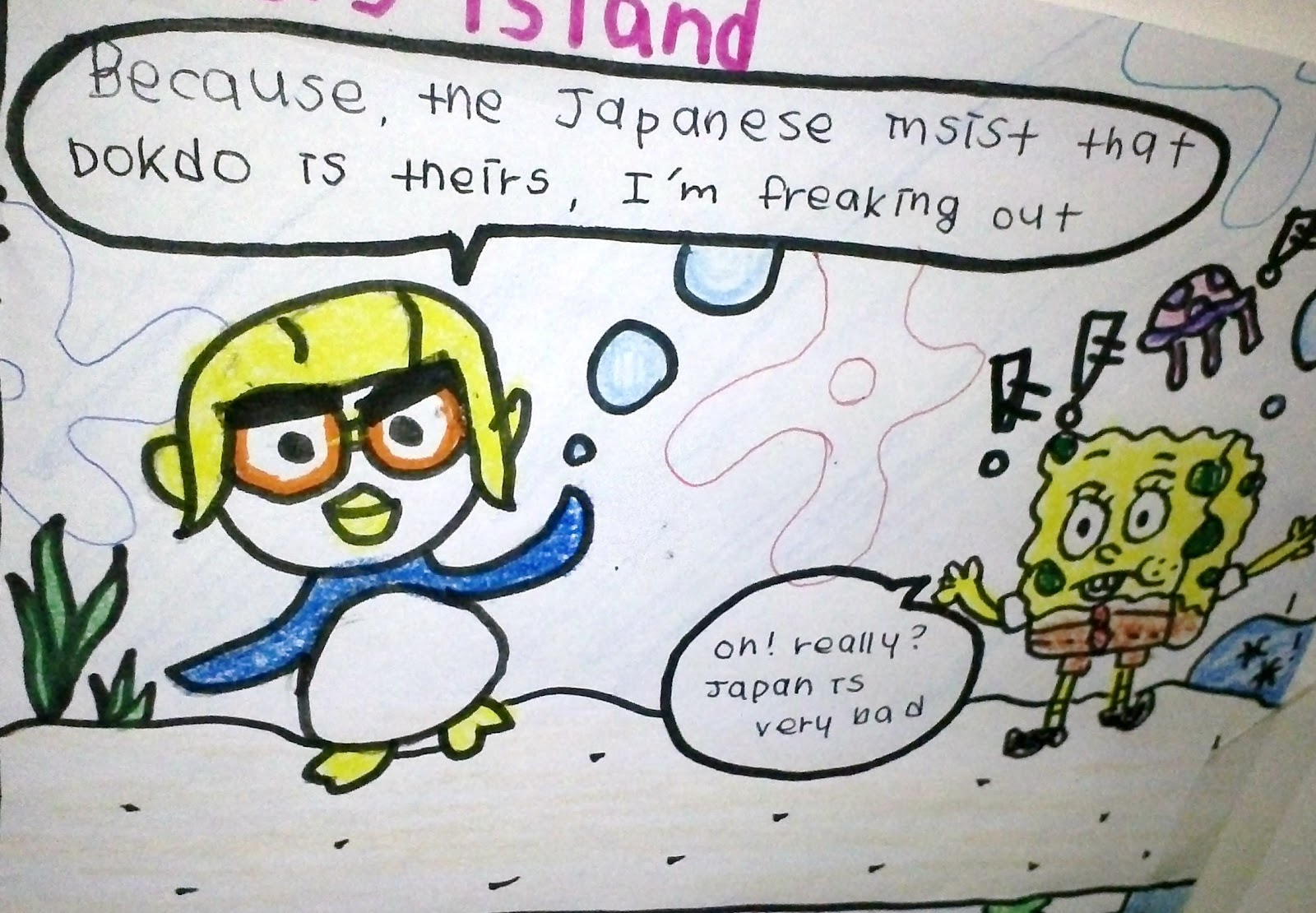
I am always looking for new ways to motivate my students in English conversation class. I have recently started dedicating a short amount of class time to teaching them slang. I have covered  the terms cool and sweet, as well as the phrases crazy about and freaking out

After mid-term exams the students were tired and in need of time to relax. I designed an assignment which would allow them to creatively practice using these words and phrases: In groups of 3 Design a comic strip using the four slang vocabulary words you learned this semester. Be creative. 

I turned on my new favourite grooveshark.com playlist, thanks Allieren, and put them to work.

My students didn't shy away from any of the big issues. They managed to 
  • discuss the marginalization of transgender individuals 
  • address the political tensions between Japan and Korea 
  • highlight rejection, unfaithfulness, and suicide 
  • create awareness about the dangers of vampires
  • comment on the popular Korean hit Gangnam Style.
For your viewing pleasure, some of my favourite comic strips:


She-Man


 Dokdo is Korea's Island


The Younger Woman


Rejection and Suicide


 Beware of Vampires


Oppa Gangnam Style


And, last -- but not least-- a cartoon that I thought was very interesting... appropriately titled: 


 Crazy Boys


Wednesday, 5 September 2012

Divide and Conquer: Four classroom management tips that work


Mid August marks the beginning of the second term in the Korean public school system. During the first term I assessed the issues I was having with students. After thinking long and hard, and researching longer and harder, I devised 4 extremely effective class room management and language teaching techniques.

Please note: I am privileged with a very large classroom. In the back of my room there are 5 computers, a comfy couch, to benches, and two drawing tables.


The middle of the class is the seating area for my students. I have anywhere from 15-28 students per class and about 35 desks and chairs.

At the front of my classroom I have 2 of my own personal computers. One of these computers is hooked up to a projector. 

I also have 6 fantastic co-teachers at my disposal.

1. U-shaped seating arrangement
During the first semester I kept my classroom as I had found it. There were 6 different groups of desks. In each group three students sat facing three other students. Although this arrangement can be very effective for a multi-lingual class where students are eager to speak English with their classmates, it is not the best arrangement to manage a rowdy, mono-lingual, high school classroom. I rearranged my class into a U-shape. This way I can easily make eye-contact with all my students and get their attention quickly or stare down any chit-chatters.


2. Individual Folders for English Class
English Conversation teachers do not give grades and a student could easily approach the course in a throw-away manner. I decided I would need to instill some alternative sort of value after I watched my students crumple up worksheets and toss them in the garbage. I made a request that the school purchase a folder and name-tag for each of my students. I have a very supportive team and the purchases were at my disposal within a week. Now, I still cannot give my students a mark, but I can facilitate the creation of a valuable English portfolio with vocabulary pages, slang pages, and revised copies of their writing which can be used as future educational tools. I keep the portfolios in my classroom. Students take their portfolios when they arrive in class and return them to me when they leave.


3. English Names
I had initially decided against “naming” my students. I felt it would be possible for me to learn their Korean names and not interfere with their identity by insisting they answer to a foreign name. However, by the end of first semester, I had only managed to memorize three of my five hundred student's names. Two of these students were disruptive troublemakers and the other one’s name was U-gin (which sounds like Eugene). Many of my students had asked me to give them English names and I decided the first class back to school after summer vacation would be naming day. I wanted my students to be as involved as possible in this process; however, I refused to spend the duration of the school year addressing "Lady Gaga" and "Obama". So, I presented 100 popular boys names and 100 popular girls names. Students were given 10 minutes to choose a name while my co-teacher and I walked around and helped any students wanting name suggestions.  Once they chose a name they were instructed to take a portfolio and personalize it with a name tag. I try to have students move around as much as possible during my class. Rather than passing out worksheets, I find it is better to instruct students  to stand up, stretch, and walk to the materials.


4. The Final and Most Important Tip:  
Divide and Conquer                   
Divide et impera: It's effective in war, and it's effective in a high school classroom.

After a 10 minute introduction to the topic of a class, I divide my students into three groups. Each group rotates  between 3 stations and spends between 10-12 minutes researching, discussing, and writing about the theme of the day .


1. Computers
I give the students a simple research assignment that matches the lessons topic. I insist they research in English and use google rather than naver (the preferred Korean search engine).


2. Conversation
Station 2 is conversation with me. I introduce a discussion question and highlight new vocabulary and grammatical structures.  These  conversations have proved to be fun, engaging, and have helped me to develop deeper relationships with my students*. Even the quietest students prove to be much better at speaking when in small groups.

*Me: What's your mother's job? 
 student: My mother's job is a business man. 
 Me: Really?

3. Reading & Writing
In this station students are 
given a topic to write about and a sample piece. Creative writing can be a very difficult endeavor and it is very helpful to have a co-teacher at this station.


Side note: Korean students and nicknames.
My co-teacher & friend informed me that students will often have nicknames for their teachers. Some of the funny & clever ones she’d heard were Submarine (for a short bald teacher), and Upside-down Tri-angle (for a teacher with a big chest and small lower-body). I asked her if I had a nickname and she laughed: Water-purifier.  I wasn’t flattered or insulted. I was simply confused. She explained that there is a Korean commercial that advertises a water purifier that takes all the bad elements out of the water and leaves it in a purified, drinkable state. Apparently, the analogy applies to my class. Clever students.

Tuesday, 28 August 2012

Typhoon Bolaven hits Korea


After causing a significant amount of damage in China and   Japan, the long awaited typhoon Bolaven finally hit the Korean Peninsula. In Hongseong, a town on the Western side of the country we are being hit hard - but not as hard as we had expected. In the days leading up to the the typhoon my co-teachers and students insisted that school would not be canceled. In fact, some of my students assured me that school is never canceled in Korea. However, there has been a significant amount of attention from the media and, contrary to predictions, schools all over the country have been closed. When this announcement was made yesterday, cheers of surprise and joy erupted from the 600+ students at my school and, undoubtedly, millions of other students across the country.


This may be one of the few cases when working at a Hagwon (private academy) is preferable to working at a public school. Hagwon teachers were given the day off, while we, public school teachers, were asked to come in regardless of the fact that there would be no students. Thankfully, my school has reasonable people in authority  and we were released at noon, before the winds really picked up.


By the time I arrived home, the air was littered with garbage and the small tree that Josh and I had been gauging the wind strength with was now under a truck in the parking lot. The great outdoors had turned hostile and unfriendly. We decided to weather the typhoon cradled safely in our officetel. Unfortunately, nature calls even at the most inopportune times and we needed toilet paper.


Earlier in the week we had accidentally bought a scented variety of toilet tissue and so we had no choice but to get to the grocery store and exchange our smelly purchase. The walk turned out to be quite invigorating aside from the dirt in our eyes. It was exciting to watch the trees dance and get knocked around by the wind. 


We decided to continue our adventure and head downtown for some Korean fast food and coffee. We spent the afternoon in the safety of our favourite coffee shop. The windows had been taped up so they wouldn't shatter if broken by debris from the strong winds. We had a nice view of the storm and we were even treated to  specialized lattes.
Business was slow so our barista treated us to some personalized coffee art.


Although we ended up enjoying an only  slightly-stormy surprise day off, many other parts of Korea have not been as fortunate. To quote my friend, and fellow teacher Tijana Huysamen:
During Typhoon Bolaven 54 people became homeless, 10 people went missing and 4 people are dead...2 ships sank, 1 broke in half.. a Truck was overturned, a church steeple fell down, a few houses crumbled... and yet all of us in our concrete forts never thought it was that bad because of course Korea has diligent workers who literally clean everything up as it happens. Korea you amaze me sometimes.

At the time that I am now posting, the reports have gotten much worse. According to channelnewsasia.com

Twelve people were killed and 10 were missing after a strong typhoon pounded South Korea on Tuesday, uprooting trees, sinking ships and cutting power to almost 200,000 homes.

Further Reading:

Tuesday, 14 August 2012

Your first day teaching English at a Public High School in South Korea: The Introduction Lesson


so the big day has finally arrived. Many things led up to this day: deciding to come to South Korea, finding a recruiter, filling out a gigantic application, gathering documents, waiting for the interview, waiting for the interview results, applying for the E2 visa, waiting for the visa, getting the visa, booking the flight. And now, you are here and your first day of teaching has arrived. What to do?

You may be a little confused about what the expectations are regarding your first week of teaching. Luckily for me, my first day was very easy: there were no classes. After being introduced to my co-teachers and given a tour of the school and my classroom I was told to go back to my officetel  and “take a rest”. I asked what I should prepare for classes the following day, and I was simply told “Just introduce yourself. Very easy.”

Hmmm. Introducing myself takes 5 minutes (at best). Saying my name, where I'm from and some of my hobbies certainly wouldn't fill the 50 minute time slot for each of my 5 classes. I considered teaching a simple lesson and doing icebreakers until I did a bit of research.

I discovered that introducing yourself in Korean culture is different and, perhaps, a bit more elaborate than a typical Western World introduction. If you want your students to talk to you and feel comfortable around you, you must introduce yourself to them in a way that corresponds to the Korean standard. This means divulging more information than you may consider necessary (such as your age, relationship status, and sometimes religious beliefs).

I am fortunate enough to have a classroom with 2 computers, a projector, access to power-point and the internet. I will outline what I did for my introduction class. This is the lesson I taught to each of my 24 classes during my first week in South Korea. It went over very well with my co-teachers and students. Feel free to use this as a template for your first day.

Slide 1: Welcome to English Class: 
I LOVE English!
This is the slide my students saw when they entered the classroom. I wanted them to feel welcome and create a positive mood in the classroom.

Slide 2: My name is ________.
Your new students may be nervous to meet you and find it difficult to understand you if you speak quickly. However, their reading skills are usually very high. If they can't understand what you are saying they will certainly be able to read this easy introduction. You should tell your students your name and age. By this point, you have, very likely, already been asked your age by your co-teachers. If you don't tell your students how old you are, they will soon ask you. In Korean culture, you must know someone's age in order to know how to address them. This is a very normal question and they do not mean to offend you!

Slide 3-4-5: I am from ____________.
Tell them your home-country, show your country's flag, a map, your home province/state, city/town.

Slide 6-7-8: This is my family.
Show pictures of your parents, siblings, gf/bf, husband/wife. Students want to know about you and your background. Take note: Your co-teachers and students WILL ask about your relationship status. Whether you are single or in a relationship you might as well let them know on your own terms.

When introducing your family you can add language value to your lesson by helping them brush up on vocabulary words: mother, father, sister, brother, grandmother, grandfather, aunt, uncle, etc.. When I showed a picture of my grandmother I asked: "Who do you think this is? How old do you think she is?"

Your co-teachers and students may also ask you about your religious beliefs. Be prepared!!
I decided against discussing my religious beliefs in my class. However, many of my co-teachers and students have asked me about my beliefs and I have discussed this with them privately.

***Side Note*** Ultra-personal questions: During my first week of school I was approached by two fellow-teachers. They asked me how much money my husband made. 

Slide 9-10-11: Your hobbies
I like playing music, travelling, eating delicious food, and teaching. I showed them pictures of me doing all of the above. Once again, take this opportunity to interact with your students. I had a picture of me playing the ukulele. I asked them: “What is the name of this instrument?” Most students didn't know. This is a great way to add learning and language value to your introduction lesson. Same thing goes for travelling pictures. I showed my students a picture of me in Paris standing in front of the Eiffel tower. I asked them “Where was this picture taken? What is the name of this tower?"

Slide 12: Getting to know your students
In the last part of my introduction I told my students how excited I was to meet them and have the opportunity to teach them English. Then, I told them it was now their turn to introduce themselves. Make this activity fun and interactive by choosing an out-going student to start the introduction. I told them to say their name and one of their hobbies. Give them an example first (they may be VERY nervous to speak English in front of you and their classmates). Ex: My name is ____ and I love playing the ukulele.
After the first student has introduced herself/himself ask him/her to choose the next person. This keeps the students on their toes and gives them another chance to speak English (they can gesture to the student they wish to be introduced next and say “Please stand up and introduce yourself.”

Depending on the size of your class, you may have time left over once this introduction activity is finished. I prepared a very simple survey for my students to do if there was time left at the end of class. They were asked to simply interview 2 other students and ask them 8 easy questions. Ex: how many brothers do you have, what is your favourite food?


Make sure to instruct them to write full sentences and to be prepared to share their answers with the class once they have completed the survey. While they are doing this activity, it is a great opportunity for you to walk around and interact with your students individually.

By introducing yourself thoroughly you will engage your co-teachers and students. The people at your new school will, very likely, be curious about you and eager for information. Having an interesting, informative, and educational first lesson is a great way to kick-start your school year.


***Side Note*** You may or may not be fortunate enough to have power-point and a projector in your classroom. Packing pictures of your family, travels, and hobbies is a good idea.

For further reading, check out this highly informative and amusing blog: Kimchi Icecream

Top 5 things to pack when moving to South Korea


Are you moving to South Korea and not sure what to pack?

THE TOP FIVE LIST

1. Bed Sheets
2. Your Favourite Products
3. Deodorant
4. Advil Cold & Sinus
5. Your Favourite Non-perishable Foods


Your E2 visa has arrived and your flight is booked. Now it's time to pack. Here is a list of what I think are important things to take. Keep in mind, this a highly developed country and you will be able to get, more or less, anything you want.

1. Bed Sheets
This really took us by surprise when we first arrived at our officetel (What Koreans call small apartments- a combination of 'office' and 'hotel').


In South Korea, beds dress a bit differently than they do in the Western World. In Canada, beds like to wear a tight fitting bottom sheet, then cover with two additional layers. Normally a comforter or feather duvet (depending on the season). My beds have always dressed well and have usually opted for subdued, natural tones.

In South Korea, beds dress loosely, scantily, even flashy. We found our mattress lying naked, covered only with a loose bed mat & matching comforter. The mattress was exposing itself on both sides. To top this off, our mattress was wearing a bright pink garment with flashy blue designs. Luckily, with a little help from our co-teachers, we were able to order some more appropriate bedclothes.
***Side Note*** You may also want to pack some full-size towels. Koreans use, what we would consider, hand towels to dry off after a shower. I have grown used to these small towels and even prefer them to full-size ones. A lot of Westerners don't, so you may want to consider packing 1 or 2 big towels.
2.Your Favourite Products
If there are any specialty products you like to use for your skin, hair, or body - make sure to take them with you.

I am a big fan of Green Beaver products. I filled my suitcase with deodorant, facial cream, shampoo, conditioner, hand-cream, sunscreen, and lip balm. My only regret is I didn't pack enough to last the whole year. Green beaver is a fantastic Canadian company that uses wild, organic Canadian products. Their stuff is so natural you can eat it. Oatmeal facial cream, yum.

I also packed 2 bottles of Thayers Witch Hazel. I consider this to be the fountain of youth regarding skin care. I love it so much. Whether your skin is dry, oily, pimply, or blotchy, this stuff will fix and refresh your face.


3. Deodorant

Most Koreans don't sweat or stink to the same extent as Westerners. My Korean friends don't even wear deodrant and they smell fantastic, even in 40°C+ weather. Josh and I, on the other hand, don't. Pack a lot.


4. Advil Cold & Sinus
If possible, I always choose a natural approach to health: drinking lots of water, eating healthy foods with Vitamin C, and including fresh garlic in daily meals. However, you may still get sick, especially when you are exposed to the monster flu bugs that live in South Korea. They don't carry Advil here. When we got sick during our first month it was difficult to get the type of medicine with which we were familiar. Apparently, our local drug store carries Neocitron. Unfortunately, they had sold out during flu season, when we needed it.

You should also pack peptobismol, Buckleys, Advil Gel Caps, and whatever else you may need. I am sure you can find most of these products, or their equivalents, in South Korea. But, you probably don't want to be running around from pharmacy to pharmacy and calling the tourist help line translation bureau when you are suffering from diarrhea.


5.Your favourite non-perishable foods

I have had many conversations with ex-pats about the absence of good cheese in South Korea. Yes, you can buy processed cheese, and cheese sticks galore. But, it is very difficult to find a nice gouda and nearly impossible to find feta. For my birthday, my mother sent me a bottle of Parmesan and a bottle of Romano. As far as shaker bottle cheeses go, these are quite tasty. They aren't fresh, but they are the next best thing. Josh's mother also sent me some rennet so I can make my own cheese.

If you are like me, and cannot survive without cheese, I recommend packing some of the high quality, bottled, hard variety. If you're ambitious, some rennet. Other things to consider packing (for those moments when you want to be less than healthy):

  • Kraft Dinner (or as the Americans say :Mac&Cheese)
  • Salad Dressing (creamy caesar, ranch)
  • Ginger Ale (you can't get it here)
  • Crackers (Korean crackers are usually coated with sugar)

You will find many great products when you move to South Korea. Products you will probably be stuffing into your suitcase when you eventually return to your home country. 
However, there are things you will really miss and really wish you had. Hopefully this list will help you to pack smart and, when you arrive, maybe even ease the product separation anxiety from which many of us ex-pats suffer.

*** Side note*** If you live in the USA or close to the USA/Canada border (like my family) you can ask someone to send you a medium flat rate box of goodies using the US Postal Service for under 50 USD.

Thanks Mom :)